Nineteen accounts. Balances she'd stopped opening mail to avoid. And a payoff plan that only worked once it was designed for the brain she has.
When Maya finally listed everything, the total came to about $58,000 — credit cards, store cards, a personal loan, all of it accumulated in ordinary ways: a car repair here, a tough month there, a balance transfer that bought breathing room and then quietly refilled. None of it was extravagant. All of it was heavy.
The part that hurt most wasn't the number. It was the juggling: due dates scattered across the month, minimums she sometimes paid twice and sometimes missed entirely, late fees landing on money she actually had. The debt was expensive. Managing it with an ADHD brain was making it more expensive.
Her first plan was the mathematically optimal one: attack the highest interest rate first, track everything in a detailed spreadsheet. It lasted eleven days. The spreadsheet needed daily attention her brain wouldn't give it, the target balance barely moved, and with no visible win, the plan stopped feeling real.
The second plan flipped the order. She lined the debts up smallest to largest and attacked the little ones first — not because it's optimal math, but because closing an account in month one gave her proof the plan was alive. Every closed account became fuel for the next one. That's the snowball method, and for an interest-driven brain, momentum is worth more than a fraction of a percent.
Underneath the plan, she built rails: every minimum on autopay, all due dates moved to the week after payday where the lenders allowed it, and one weekly ten-minute money date — same time, same coffee shop — where the only job was to look. No fixing, no judging. Just looking, so nothing could ambush her.
The plan isn't finished, and it hasn't been perfect — there was a month with an emergency vet bill that went straight back on a card. The difference is what happened next: the rails held, the minimums paid themselves, and the plan resumed the following month instead of collapsing. Progress you can restart is worth more than perfection you can't.
If Maya's spreadsheet graveyard looks familiar, start smaller than you think you should: list every balance, autopay every minimum, and pick the smallest debt to kill first. The win is the strategy.
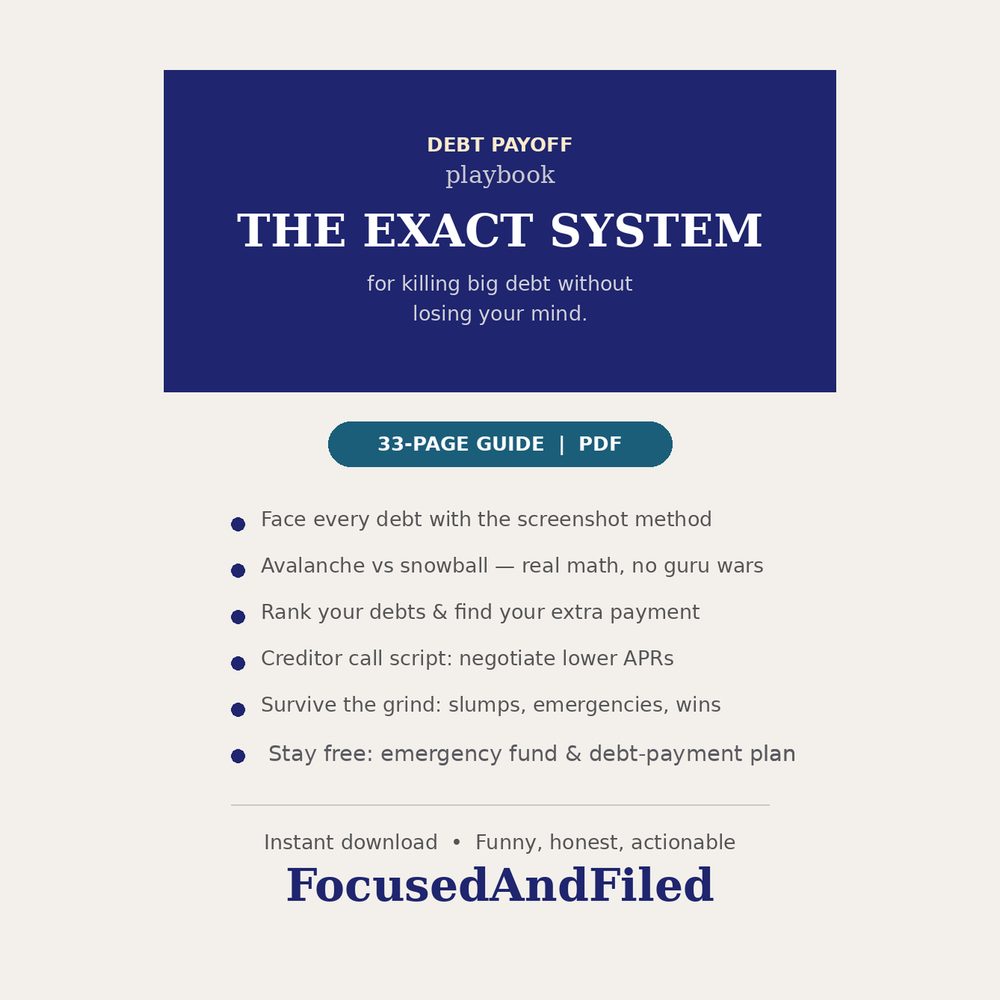
The done-for-you version
The printable system behind stories like Maya's: snowball trackers, payoff maps, and minimum-payment rails — using fictional examples, never your real numbers.